
Quick Answer for Travelers
Bat Trang is a 700-year-old artisan village located 14km southeast of Hanoi along the Red River dike in Gia Lam District. Renowned across East Asia since the 14th century for imperial and export ceramics, it is today a premier day-trip destination. Entering the village and exploring the vast Bat Trang Porcelain Market (Cho Gom) is completely free. Hands-on pottery wheel classes run 40,000–60,000 VND per person at local family workshops. The striking Bat Trang Ceramic Museum features seven spiral terracotta towers showcasing historical dynasties of stoneware for a 50,000 VND entry fee.
Fast Facts at a Glance
| Location | Bat Trang Commune, Gia Lam District, Hanoi (Coordinates: 20.9782° N, 105.9125° E) |
|---|---|
| Time Needed | Half-day (3 to 4 hours including transit and workshop session) |
| Opening Hours | Village workshops open daily 08:00–17:30; Bat Trang Ceramic Market open 08:00–18:30 |
| Admission Fee | Village entry free; Pottery workshop fee 40,000–60,000 VND; Ceramic Museum 50,000 VND |
| Best Time to Visit | Weekday mornings (08:30–11:30) to avoid domestic weekend school crowds |
| Nearest Transit | Public Bus 47A from Long Bien Interchange (7,000 VND); Grab car costs approx. 180,000 VND |
| Ideal For | Families with children, hands-on craft lovers, home decor shoppers, cultural travelers |
Why Go: Seven Centuries of Ceramic Mastery
When King Ly Thai To founded Thang Long in 1010, the burgeoning royal court required immense quantities of roof tiles, floor bricks, ceremonial vessels, and household dishes. In the 14th century, five prominent potter families from Bo Bat village in modern Ninh Binh province migrated northward, following the Red River until they reached a high clay terrace rich in pure white sedimentary clay (Dat Set Trang). Establishing their new settlement at Bat Trang ("Great Workshop"), they positioned the village on the river's eastern flood plain, where barges could effortlessly transport wood fuel downriver and ship finished ceramic wares directly to the capital and the maritime ports of Hai Phong and Hoi An.
By the 15th and 16th centuries, Bat Trang ceramics had attained international fame. Merchant vessels from Japan, the Ryukyu Kingdom, the Netherlands, and Ming Dynasty China called at Vietnamese trading ports specifically to buy Bat Trang crackle-glaze tea bowls, celadon ewers, and blue-and-white porcelain vases. Japanese tea masters prized Bat Trang wares—known in Japanese tea culture as Kochi-yaki—for their organic, unpretentious aesthetic and warm tactile qualities.
Today, Bat Trang seamlessly bridges ancient craftsmanship and 21st-century production. Navigating the village's narrow paved alleys (Ngo Gom), you pass ancient moss-covered brick walls embedded with kiln fragments, drying racks stacked with freshly turned tea cups, and gas-fired tunnel kilns humming in family courtyards. For visitors seeking to understand Vietnam's handicraft heritage, Bat Trang provides an authentic, sensory encounter with the earth, water, and fire that built the country.
Key Highlights in Bat Trang
Plan your walking route through the village around these distinct cultural and retail zones:
- The Bat Trang Ceramic Market (Cho Gom Bat Trang): A massive covered bazaar housing hundreds of artisan stalls. Here you will find everything from traditional hand-painted celadon tea sets and ornate ancestor altar incense burners to minimalist contemporary espresso cups, ceramic planters, and decorative tiles. Prices are significantly lower than in the Hanoi Old Quarter, and friendly bargaining is customary.
- Vietnam Craft Village Quintessence Center (Bat Trang Ceramic Museum): Located at the village entrance along the Red River dike. Designed by architect Hoang Thuc Hao, the museum's sculptural exterior features seven curving terracotta towers inspired by clay thrown on a manual wheel. Inside, multi-level galleries display archaeological kiln artifacts, historic imperial ceramics, and interactive video installations detailing traditional glaze chemistry.
- Ancient Village Alleys (Lang Co): Walk west from the market toward the Red River bank to explore Bat Trang's original settlement. The streets here are narrow, barely wide enough for two motorbikes to pass, bounded by walls constructed from discarded clay molds and kiln bricks that have absorbed heat and soot for centuries.
- Bat Trang Communal House (Dinh Bat Trang): Built in 1720 facing the Red River. Dedicated to the village guardian deities and the founding master artisans who established the trade guilds. The communal house features intricate ironwood carvings of dragons and phoenixes and remains the spiritual heart of the community.
Hands-On Experience: The Pottery Wheel Workshop
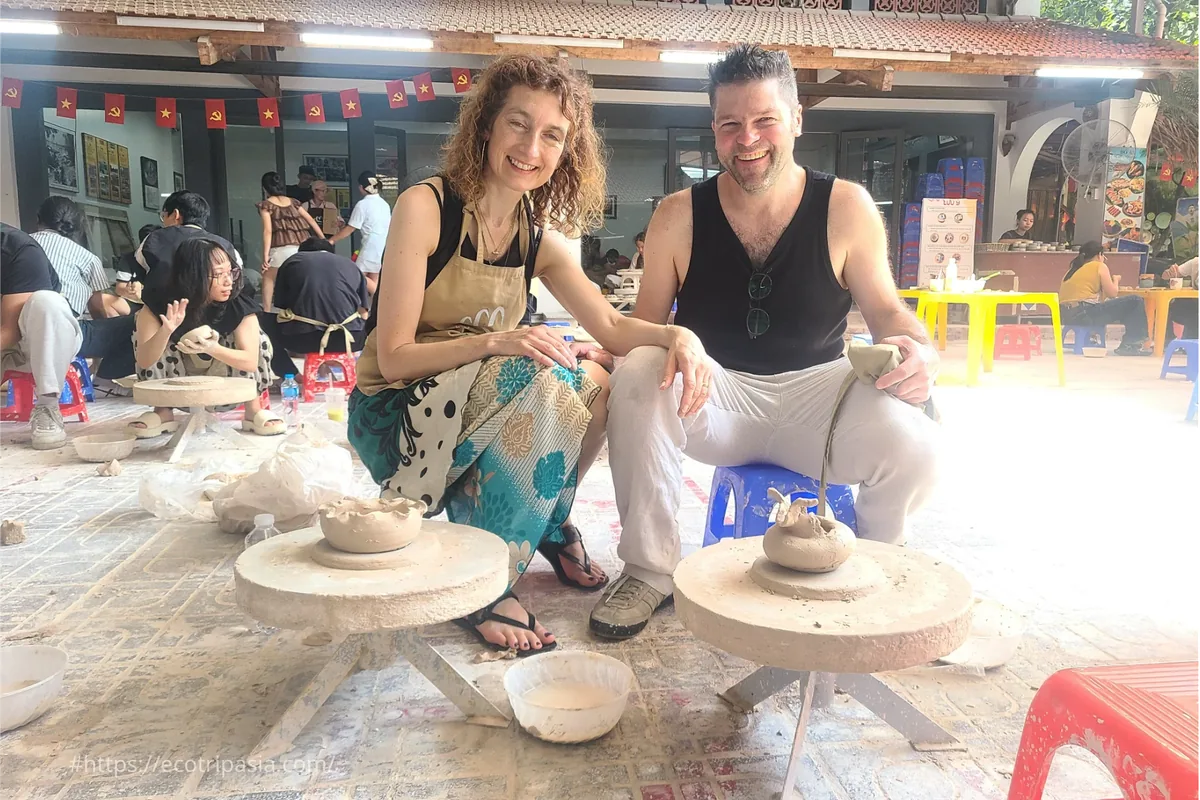
The defining activity for travelers visiting Bat Trang is sitting behind an authentic manual pottery wheel (Ban Xoay). Dozens of family workshops along Giang Cao and Bat Trang streets welcome walk-in visitors:
- Centering the Clay: You will be provided with a sturdy apron and a lump of wet, dense riverbed clay placed in the center of a foot-powered or electric spinning wheel. A local instructor will guide your hands to center the clay, demonstrating how finger pressure alters the shape.
- Pulling the Walls: Using water and gentle inward thumb pressure, you will pull the rotating clay upward to form the walls of a cup, small vase, or bowl. Even if your initial attempt wobbles or collapses, instructors patiently assist in resetting the clay.
- Trimming & Detailing: Once the vessel takes form, use wooden ribs and bamboo scrapers to trim excess clay from the foot and carve decorative spiral motifs or your name into the wet surface.
- Firing and Glazing: For a nominal fee (30,000–50,000 VND), the workshop will dry your creation, apply a traditional glaze, fire it in their kiln, and have it packaged or delivered to your hotel in central Hanoi within 24 to 48 hours.
Photographic Gallery: Craft of Bat Trang

How to Get There: Transport Logistics
Reaching Bat Trang from central Hanoi is convenient via several transport options:
- Public City Bus (Line 47A): The most economical route. Board bus 47A at the Long Bien Bus Interchange (directly northeast of the Old Quarter). The bus runs every 15–20 minutes and terminates directly at the entrance of Bat Trang Ceramic Market. Fare is 7,000 VND ($0.30 USD) each way; travel time is approximately 45 to 60 minutes depending on traffic along the dike.
- Ride-Hailing (Grab / Taxi): A 4-seater car ride from Hoan Kiem Lake takes 30 to 40 minutes along the Red River dike road (DT378) and costs between 160,000 and 200,000 VND ($6.50–$8.00 USD). Booking a return ride from the village via the Grab app is generally easy during daylight hours.
- Motorbike Ride: Driving yourself by scooter offers a scenic ride across Vinh Tuy or Chuong Duong bridges and along the elevated Red River embankment road. Exercise caution on the dike road, as large construction trucks frequently use the route.
Look for the "Men Ran" Crackle Glaze: If you are shopping for a meaningful keepsake, bypass mass-produced printed ceramics and ask vendors for authentic Men Ran (crackle glaze) ware. This traditional glaze technique, perfected in Bat Trang during the late 16th century, deliberately induces microscopic crackle networks across an ivory or celadon background using natural river silt and feldspar minerals. Tap the rim gently with a finger; authentic high-fired Bat Trang stoneware rings with a clear, bell-like chime.
Visit Bat Trang by Open-Air Army Jeep
Eco Trip Asia's countryside jeep tour navigates rural Red River agricultural villages, guava orchards, and banana plantations to reach Bat Trang, including private access to a master ceramic studio and hands-on throwing lesson.
All tours operated directly by Vietnam Green Travel Co., Ltd (Licence 01-3022/2025/CDLQGVN-GP LHQT). Transparent flat pricing with zero booking markups.
Frequently Asked Questions About Bat Trang
How far is Bat Trang Pottery Village from central Hanoi?
Bat Trang is located approximately 14 kilometers (8.7 miles) southeast of central Hanoi on the eastern bank of the Red River in Gia Lam District. Travel time is roughly 30 to 45 minutes by taxi or Grab, or 60 minutes by public bus.
How much does a pottery-making class cost in Bat Trang?
Hands-on pottery throwing classes at local family workshops cost between 40,000 and 60,000 VND ($1.60–$2.50 USD) for clay and wheel access. If you want your creation fired in a kiln and painted with colored glaze to take home, workshops charge an additional 30,000 to 50,000 VND.
How do I take the public bus to Bat Trang from Hanoi?
Board public bus line 47A from Long Bien Bus Interchange directly to the Bat Trang bus terminal. The fare is 7,000 VND ($0.30 USD), and buses depart every 15 to 20 minutes from 05:00 to 20:00.
What is the Bat Trang Ceramic Museum?
The Vietnam Craft Village Quintessence Center (Bat Trang Ceramic Museum) is a landmark multi-story architectural complex designed in the shape of seven giant terracotta pottery wheels. Admission is 50,000 VND for the heritage galleries.
What are the authentic hallmarks of Bat Trang ceramic ware?
Authentic Bat Trang ceramics feature white clay bodies fired at high temperatures (over 1,200°C), traditional crackle glazes (men ran), cobalt blue dragon and lotus brushwork, and heavy, durable wall thickness compared to industrial porcelain.
Nearby Sights & City Guides to Combine
Pair your countryside craft excursion with these central Hanoi destinations:

Hanoi Old Quarter
Where Bat Trang ceramics have been traded along Hang Chenh and Hang Bat for centuries.

Three Days in Hanoi Itinerary
How to integrate a half-day countryside craft excursion into a 72-hour trip.

Hanoi Egg Coffee Guide
Sip authentic whipped yolk coffee served in custom Bat Trang ceramic cups.